
Team Coaching
Teams that work know where they’re going. The rest can be trained.
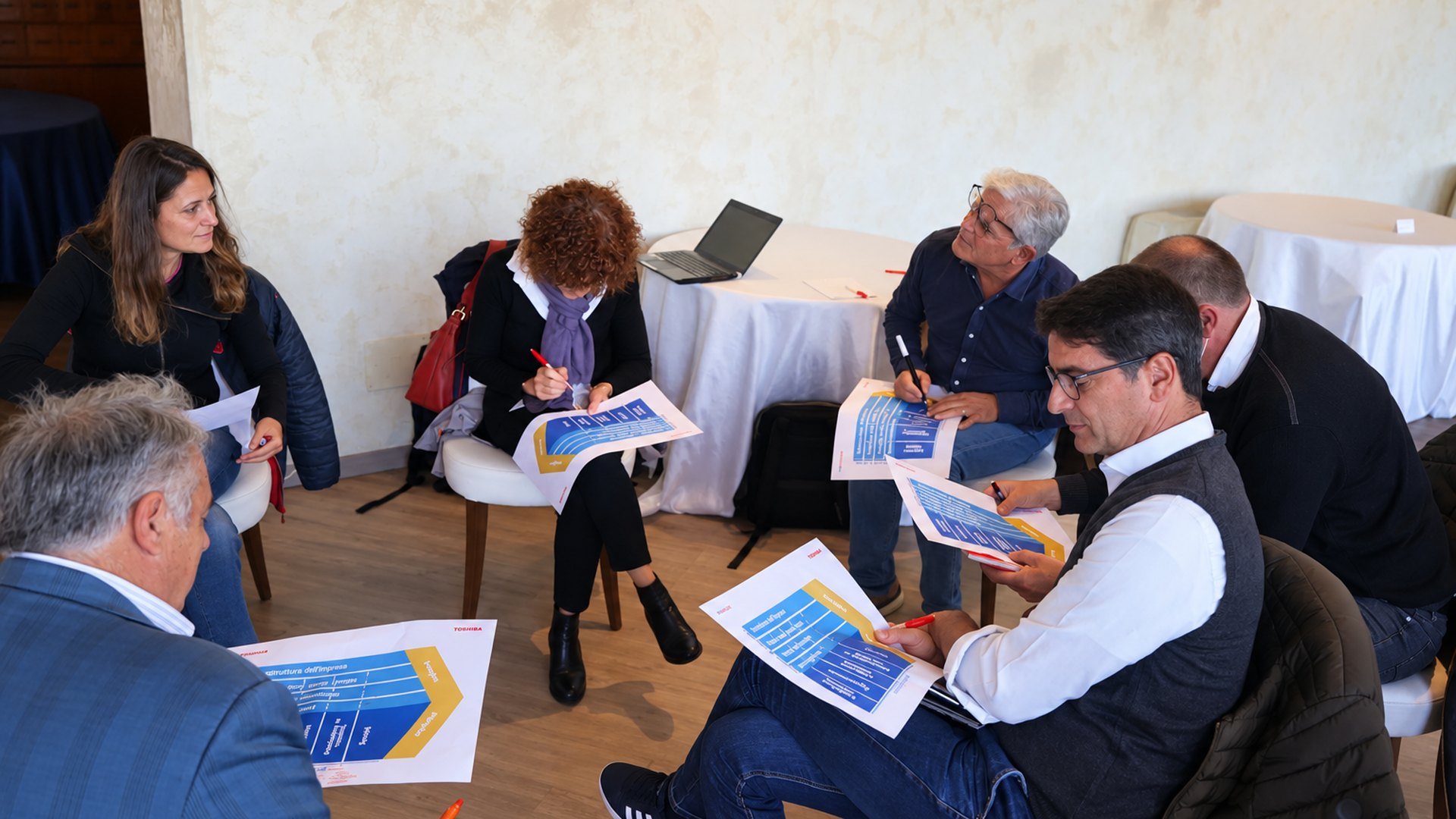
What we’ve seen
It took us years to put it this plainly, and it comes from watching the same thing happen hundreds of times, in the room and in the field: the teams that work are the ones that know where they’re going, before they’re the ones that get on best.
Getting on helps. Technical training helps. And still we’ve watched likeable, competent teams lose months because nobody had ever written down what the real priority was, or because three people were quietly using three different definitions of the same word. And we’ve watched teams with rough relationships go a long way, because on where they were going there was one voice.
That’s why we call our work Team Alignment: the process that turns a group of people who collaborate into a team with a shared course. Decisions get shorter, friction goes down, and the results can be measured, because we check them at fixed points all the way through. What clients tell us afterwards is consistent: people more involved than they were, collaboration between departments that runs more easily, and a clearer sense of what the company is for.
Team Coaching is the structured form of that work.
What Team Coaching is
Coaching means training, and the word says almost all of it. A consultant brings the answer. A lecturer brings the syllabus. A coach brings the questions, and stays until the team has found its own answers. Team Coaching is a path where a group, accompanied by someone who has already seen hundreds of groups, works on its own processes and its own performance, starting from exactly where it is.
You work on two planes at once. The content plane: where we’re going, why, with which priorities, under which rules. The process plane: how we talk to each other, how we decide, how we handle disagreement, how we use our time. The second one almost always stays outside the room, and that’s where most of the value goes missing.
Why a company like ours does this
Because we always alternate working sessions with experiential training. A concept discussed around a table lasts a fortnight. The same concept lived through in an activity stays.
The formats you’ll find under Activities are also the instruments we use to check whether a declared alignment is a real one. In a meeting room everybody agrees; in front of an Escape Box with the timer running down you see who decides, who listens and who waits. That’s why here Team Coaching is done by a team building company: we’ve had the testing ground all along.
What makes it different from a team building
A team building is a day, and it surfaces a great deal. A path is work over time, and the differences start before the first day and finish long after the last.
The starting point. A team building starts from the format: you choose the activity that suits the group and the occasion. Performing Tribes starts from the fix, two profiles drawn before anything begins, one for each person and one for the team, and an Alignment phase on vision, mission, values, competences, actions and environment. The activities come afterwards, and they’re chosen as tests of what the team has declared.
The objective. In a team building the objective can be a good day together, and that’s legitimate. In a path the objective is stated at the start, translated into behaviour you can observe, and checked at fixed points: you know what has to be different, and you check whether it is.
The two planes. A single day works mostly on relationships and on the energy of the group. The path works on the content plane, meaning where we’re going with which priorities and rules, and on the process plane at the same time: how we talk to each other, how we decide, how we handle disagreement, how we use our time. The second is the one a single day barely gets to touch.
Time. A group’s habits took years to form: a day makes them visible, changing them asks for sessions spaced out, where the team tries, goes back to work, measures and corrects. The cycle that a team building completes once, experience, observation, awareness, alignment and action, repeats at every phase of the path, and every phase tests what the previous one declared.
Who’s involved. A team building often gets organised for the team. A path involves whoever leads it: the opening briefing with the manager, decisions taken by the team together with them, a commitment that starts at the top. And the coach stays the same from beginning to end, because the trust it takes to say things out loud is built that way too.
The team’s role. In a single day the group takes part. In a path it decides: in the Alignment phase it chooses together what to keep and what to change, says it out loud, and from there on answers for it. Responsibility for what changes passes to the team, and that’s why the change holds up after we’ve gone.
What’s left. A team building leaves a shared memory and, when it’s done well, a decision. The path leaves the two profiles, a common language, decisions with an owner and a date, the check-ins on dedicated days, a review before the close, and a moment of recognition that fixes what has changed.
It always starts from the same point
Our path is called Performing Tribes and it’s organised in phases. The first is always Alignment. We’re very firm about this, and we’d like to convince you too, because it’s exactly the phase almost every company would rather skip. Asking when a team should do this work is a bit like asking when it’s useful to go to the gym: potentially always, and in practice when there’s something specific to get ready for.
It happens a lot: a company wants to work on the end objectives without knowing the point it’s starting from. It’s like plotting a course without having taken a fix. You can do it, and you’ll arrive somewhere. Here the fix comes first, and it’s taken twice, on the team and on each person.
Where the method comes from

The work on alignment didn’t start in a training room. Before it became a path for teams it was a personal question: what happens when somebody stops being subjected to their own time and starts deciding it.
Giovanni Gambardella wrote it down in Il Tempo Vola e il Pilota Sei Tu, published in English as Time Flies and the Pilot Is You, and first in its category on Amazon. He’s a speaker and an experiential trainer, he has been working on team building and coaching for more than twenty years, across Europe and the Middle East, and the same idea runs through his TEDx talk, Renew, Recharge, Sustain.
The metaphor in the title is also where our path starts: being at the controls instead of being a passenger. In one person it’s called the ability to choose. In a group of people working together it’s called alignment, and it’s the same operation done by more than one.
The pages of the path
Alignment
The phase you always start from: pointing all the team’s energy in one direction.
The path
Performing Tribes in detail: the phases, the timings, what happens in each one.
Assessment
How a team is made, given back to the people who make it up: an individual profile and a group profile.
Communication
Turning thoughts into words, and understanding what we communicate to ourselves before we communicate to anyone else.
The Language of Leadership
The words you lead with when giving orders isn’t enough: recognising good work, giving feedback, spending time on explanations.
Time Management
Time and priorities, the One Thing model, and why the Eisenhower matrix isn’t enough for us.
Change Management
Handling change and the pressure that comes with it. Change, or improve?
Approaches
Systemic thinking, strengths, experiential, emotional intelligence, appreciative inquiry.
Team Coaching Online
The complete path for distributed teams, phase by phase.
One-to-one coaching
The same work on alignment, applied to one person instead of a group.
The questions we always get
Who is it for?
Teams that will keep working together, and it’s worth most for groups under real pressure: a team that has just been put together, two teams merged after a reorganisation, a group about to enter a new market or take on something it hasn’t done before. If the group breaks up in three months a path makes no sense: a single day is better.
How long does it last?
From a few months to a year, depending on the depth. Four meetings is the minimum that covers the basics; fifteen is the average for a team that wants to work on itself all round, and that usually means six months to a year. Alignment on its own can be done in a handful of concentrated sessions. The clearer the goal you’re working towards, whether that’s a merger, a listing or a new market, the more the path delivers.
Where do we start?
With a conversation where you tell us the situation and we tell you honestly whether you need a path or whether an activity is enough. Quite often an activity is enough, and we say so.
Is it a serious investment?
Yes, and that’s why it should be decided calmly. Taking the time to work out what the team actually needs is part of the investment, and it’s the part that decides whether the rest of it returns anything.
Where does your team start from?
The Team Alignment Check is a free test: twenty-one questions across seven dimensions. It tells you where your team is already aligned and where it isn’t, and the report arrives by email. It’s the quickest way to understand whether a path makes sense, and which point it’s worth starting from.