
Team Building for Big Events
Three hundred people in a hall, and every one of them with something to do.
What it looks like
A minute per format: what a full hall looks like when everybody has something to do.
Movie Making
Ghost in the Fort
A treasure hunt inside a fort, in teams.
With four hundred people in the hall the risk has a precise shape: thirty doing something and three hundred and seventy looking at their phones. The second risk is time: the window is ninety minutes, between the chief executive’s slot and dinner, and nobody moves it for us. The third is that there’s only one evening. If it goes badly, it goes badly in front of the whole company, and the name on the programme is yours.
What worries the organiser
The questions that reach us before a convention are always the same four, and they’re the right ones. How do you get everybody taking part, when the numbers are those of a theatre? How do you finish at the exact hour, with the dinner service waiting behind the door? How do you use a hall designed for a plenary, with rows of chairs and a stage, for an activity where people have to move and talk to each other? And how do you hold together an audience arriving from three countries, four languages and six levels of the org chart, without the activity becoming the young people’s thing or one nationality’s thing?
Each of these questions has a technical answer, and you’ll find them below. First, though, the numbers.
The numbers we’ve already done
We’ve taken a single activity up to six hundred people at once. Movie Making with six hundred participants, forty crews filming in the same afternoon and one final screening. Pasta Making with three hundred people rolling sheets, a ballroom and its gardens turned into a giant fresh pasta workshop. A cooking competition at three hundred, with the teams at the stoves and a jury. A Corporate Song written and recorded by three hundred voices. Escape Box up to three hundred, with one case per ten people. Cocktail Challenge at two hundred and sixty. Choir and orchestra past a hundred people, with a room that an hour earlier had never played anything.
Behind the formats there are twenty-five years, more than eight hundred companies and 79,450 people, a team that works in several languages, and the habit of doing the large numbers since long before anybody called them big events. The formats themselves scale to a thousand participants.
How you hold a hall of three hundred
We always start from a format, because a tested format is what guarantees that three hundred people will actually do something. Then we design it around your case: why you’re holding this convention, what the message is, who’s in the hall, what has to be left behind. To do that we have to understand the context and know who to work with: the agency running the event, human resources, the executive office, the staff of the venue. A big event works when those people are speaking the same language from the first site visit, and our work starts there, a long way before the day.
Time is the thing we’re most honest about. Every so often somebody asks us for a miracle in twenty minutes. Twenty minutes is perfectly good for an icebreaker, which opens a plenary and gets it talking. Activating two or three hundred people, taking them from an audience to teams that decide, build and present, takes time, and it’s worth giving it to them. Cutting the duration looks like a saving and is almost always the opposite: the set-up, the facilitators and the direction cost the same, and you go home with less. A facilitator booked properly, with the right time and the right energy, transfers far more value to the hall than one who has to finish in a hurry.
We handle the numbers by addition: one case per ten people, one table per ten, one crew per fifteen. You add units, and the activity stays the same for the last table as for the first. We build the programme backwards from the hour that doesn’t move, usually dinner, and in the hall there’s a central direction keeping the rhythm, with a facilitator for each cluster of tables who notices a stuck team before the team does.
International halls are our home ground. Understanding how multicultural an audience is belongs to the design: what works in a room where everybody shares a first language doesn’t work the same way with three nationalities and four languages, and you need somebody who notices that beforehand. All of us speak English, the facilitators are chosen partly for the languages present in the hall, and briefings and materials are bilingual where that helps, so that no table understands the rules later than the others.
The unexpected, finally, we’d rather prevent. The site visit, or work on the floor plan and the photographs when the venue is far away; the constraints of the hall, rows of chairs, stage, columns, acoustics, put into the design before the day itself; the set-up done while the plenary is still running; the number of participants confirmed with a margin; the agenda read through with whoever manages it. When an alternative is needed we prepare one, and the real work is making sure it isn’t needed.
The formats that hold big numbers
Escape Box
A locked case, a timer, boxes nested one inside another. It only opens if everyone says out loud what they’ve found. Up to three hundred people in a meeting room, and in the Escape Together version the teams discover that the final code belongs to all of them.
Pasta Making
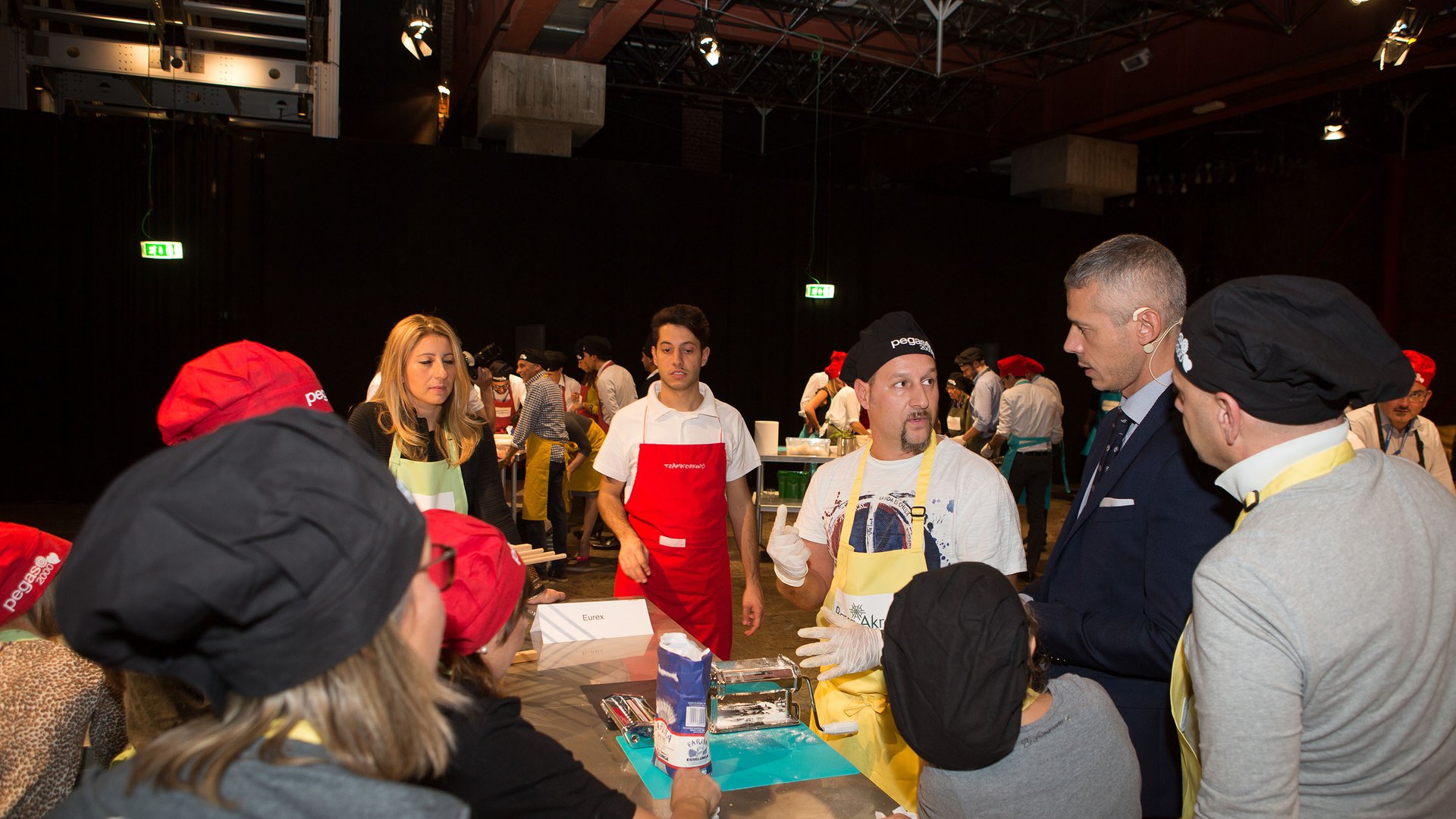
The kitchen turns into a pasta workshop and colleagues turn into pasta makers. It’s the format that scales best of all, because it doesn’t depend on the oven, and it ends with everyone at the table eating what they made.
Cooking competition
Teams at the stoves, a menu to design beforehand, a jury at the end. The dish only comes out well if the teams’ timings talk to each other: with three hundred people a kitchen is a company in miniature.
Movie Making
Each team writes, shoots and edits a short film in the same afternoon. First you agree on what you’re telling, then everyone takes a role. The final screening, in front of the whole hall, is a recognition nobody can hand themselves.
Corporate Song
Three hundred people write and record a song that tells the story of the company. To write it the group has to ask itself who it is; at the end we record it for real, and it goes round the company for months.
Gospel Choir and Corporate Orchestra
Music as a common language, for audiences that have to become one voice: you only play together by listening to each other, and nobody needs to know how to play. It’s the closing moment of a convention, for when what’s needed is something that unites.
Icebreaker
To open with: ten minutes in which a plenary of strangers becomes a room that talks to itself, before the first speaker has even started.
The themed digital adventures
Escape Room Horror, Around the World in 80 Minutes, Detective Story, Formula 1 Challenge: four adventures that run from the table, with one tablet per team and the leaderboard on the plenary screen. The hall stays seated, and competes all together.
What a convention is left with
A convention always has a message: the strategy, the values, the new product, the new structure. The activity is there to get that message done rather than only heard. A song sung by three hundred people lasts longer than a slide. A short film in which the Dubai office and the Riyadh office worked in the same crew is worth more than a speech about integration. And people who spent an hour dividing up the jobs at a table write to each other the next day without copying anybody in.
For whoever organised it, something simpler is left: an evening that finished at the right hour, with everybody still in it.
Before you sign, we tell you three things
The first is which formats we’d advise against at your numbers. Some activities that are wonderful at forty people turn into an audience at four hundred, and we say so before the quotation, even at the cost of losing it.
The second is what the day will be like: the programme with the timings it genuinely needs, the number of facilitators, what we’ve planned for your hall. You’ll find it written in the proposal, so you know what you’re buying and who’s putting their name to it.
The third is who we’ve already done it with. The numbers above have names attached, and if you want to talk to somebody who organised one before you, we’ll put you in touch.
Tell us the date, the hall and the number of participants
We’ll take care of the rest: within 24 hours you get a proposal with the formats that hold your numbers, and with the ones we’d advise against at that number.
Prefer to talk? +971 50 795 9666 · info @ teambuildingincentive.ae