
Assessment
How a team is made, given back to the people who make it up.
What it’s for
The assessment gives back how each person works and how the group works. It isn’t a school report, and it isn’t a tool in the hands of whoever decides about careers. It’s for the people inside it, who almost always know less about themselves than they think.
People overrate one ability and underrate another, ignore a talent of their own entirely, don’t notice how much the context weighs on what they manage to do. The assessment puts those things in front of them, with somebody beside them who knows how to read them.
The gain for the group arrives immediately and indirectly: understanding how a colleague is made explains behaviour that from outside looked arbitrary, and removes the share of friction that came from a misunderstanding.
What it looks like
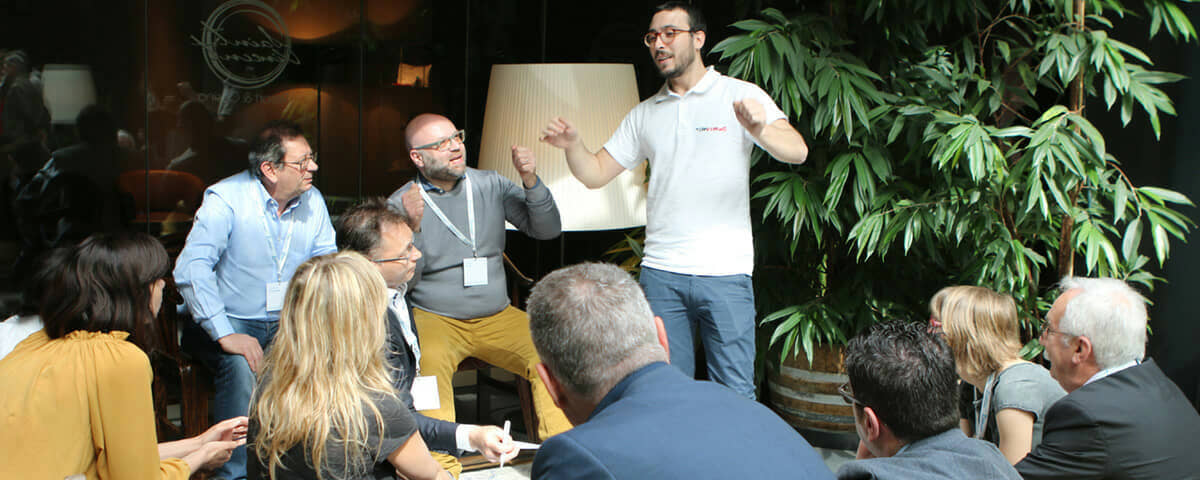
A session doesn’t resemble a test. The video gives you the tone it’s done in.
What it gives back to a person
- Whether the position they hold matches their abilities, or uses only a part of them.
- What their strengths are, including the ones they had never counted as strengths.
- Where the areas of frustration are, and what they depend on.
- How to work with people who function differently from them.
What it gives back to a team
- How to integrate different abilities and characters instead of just putting them in the same room.
- Which individual abilities can be put at the service of the group, and on which activities.
- What you can build a strategy on that will hold.
- Which values are genuinely shared, as opposed to declared.
How it runs
The assessment is made of situational exercises: a person is asked to complete a task by stepping into a given situation, rather than to answer questions about themselves. The difference matters, because what surfaces is behaviour and not the opinion somebody holds of themselves.
What gets observed isn’t the action in itself. It’s what the action lets you understand about how that person approaches things.
Where the word comes from
Assessment comes from the Latin assidere, to sit beside the judge, and from the same root come the assizes, the sittings of the judges. In English it means to evaluate and to estimate, but the sense closest to what happens here is taking stock of something: a process that lasts, not an instant verdict.
The structured method was born during the Second World War, inside the American Office of Strategic Services, which used it to select and place its own agents. From military organisations it then passed to companies.
Where it sits in the path
The assessment produces the two profiles, individual and team, that the rest of the path rests on. Without them alignment is done blind, and dividing up the work stays the opinion of whoever proposes it.
Not sure where to start? The Team Alignment Check is a free test: twenty-one questions across seven dimensions. It tells you where your team is already aligned and where it isn’t, and the report arrives by email.
Let’s talk about your next team building
You don’t need to have picked a format yet. Tell us what you want your team to take home, how many of you there are and where you’ll be, and we’ll do the rest: within 24 hours you get a considered proposal for your case, with the formats that hold up against your numbers, and what each one leaves the team the day after.
Prefer to talk? +971 50 795 9666 · info @ teambuildingincentive.ae