
Team Coaching Online
The same path, for teams that aren’t in the same place.
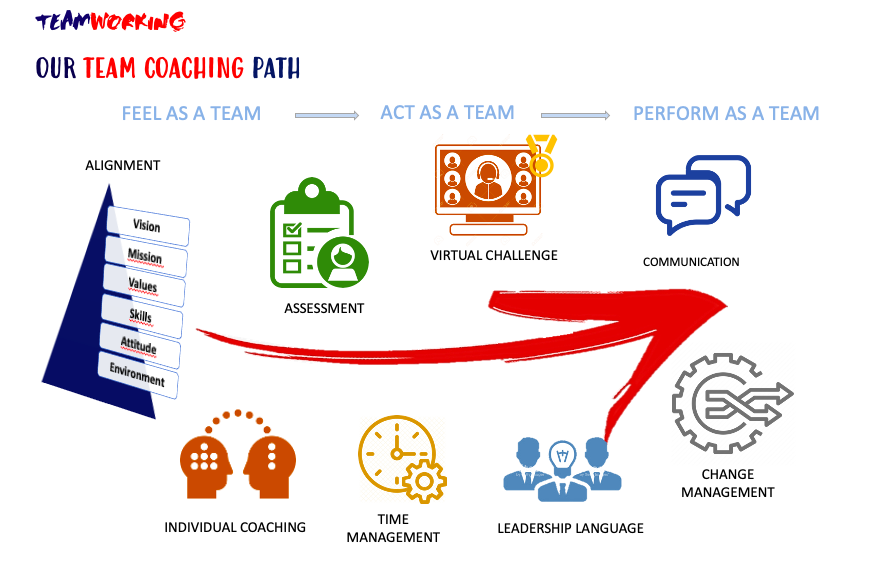
When it’s needed
The first thing a distributed team loses is everything that never makes it into the minutes: the quick exchange, the clarification on the fly, seeing from a look that something hasn’t landed. What’s left are the meetings, which are the channel least suited to surfacing a misalignment.
The online path is for when people can’t be in the same room for long enough, and what has to be worked on is still alignment, communication, and the way time and priorities get handled. In practice it does five things: it reads how each member of the team is made, it aligns everyone on one vision and one mission, it builds a sense of belonging that survives the distance, it makes the communication run more smoothly, and it gives the company back an image its own people recognise.
Phase one: aligning at a distance
You start by checking whether vision and mission already exist and are genuinely shared, or whether they have to be built from scratch. Even when they exist and are solid it’s worth asking whether they’re still the right ones: directions age, and usually nobody notices on the day it happens.
Aligning a group at a distance is harder than in person, and the instrument we do it with is visual facilitation.
Visual facilitation
Vision, mission and values can be represented with pen and paper. Drawing them does four things that discussing them doesn’t.
- It simplifies. Putting a thing down in black and white forces you to reduce it to the essential, and what’s left is its concrete shape.
- It organises. Transferring onto paper what you have in your head forces you to put it in an order, which while it stays in your head it doesn’t have.
- It clarifies. Words are conventional labels and each of us attaches our own image to them. The drawing shows which one, and the differences are visible immediately.
- It slows things down. While you’re drawing you’re not talking, and that empty space is where the listening happens.
You need paper, pens and markers, sometimes objects people already have at home. Nothing else, and that’s a choice: a tool that asks people to install software always leaves somebody behind.
The exercise that works better at a distance than in person
One person has to explain a simple, visual concept to the others without being able to show it. The others carry it out. At the end you put the result next to what was asked for.
The gap between the two is the measure of how clear that explanation was, and it isn’t arguable, because it’s right there to look at. From that point you start working on the way people communicate.
Time and priorities
At a distance, managing time gets harder. Days stretch, calls multiply, and domestic distractions keep no office hours.
The Eisenhower matrix remains a useful reference and isn’t enough to decide with. In the sessions we work on the criterion of the primary objective, the one that, once reached, makes the rest secondary, and on the difference between a list of things to do and a list of things that count. The full subject is on the Time Management page.
Phase two: assessment
The second phase is the Assessment, individual and team. It gives back how each person is made and the conditions they work best in, and makes legible the reasons behind behaviour that from outside looks arbitrary.
On the individual profile you look at whether the position held matches the abilities, what the strengths are and where the areas of frustration sit. On the team profile you look at how to integrate different abilities and characters, and which individual abilities can be put at the service of the group.
Phase three: putting it to the test
The third phase takes experiential training to a distance. The group faces challenges and problems to solve that have the air of a game and exist to surface attitudes that ordinary work keeps covered.
At a distance too the coaches observe without intervening, and take notes. The value is in the opening briefing and the closing debrief, which is the moment you look together at what actually happened.
Leading from a distance
Whoever leads a distributed group loses the informal instruments they were leaning on without ever having noticed. What’s left is the message and its consistency, and they weigh a great deal more than before.
The work on the language of leadership gets more concrete here, because an ambiguity that in an office would have been cleared up in a corridor stays, at a distance, exactly where it is.
Not sure where to start? The Team Alignment Check is a free test: twenty-one questions across seven dimensions. It tells you where your team is already aligned and where it isn’t, and the report arrives by email.
Let’s talk about your next team building
You don’t need to have picked a format yet. Tell us what you want your team to take home, how many of you there are and where you’ll be, and we’ll do the rest: within 24 hours you get a considered proposal for your case, with the formats that hold up against your numbers, and what each one leaves the team the day after.
Prefer to talk? +971 50 795 9666 · info @ teambuildingincentive.ae