
Pasta Making
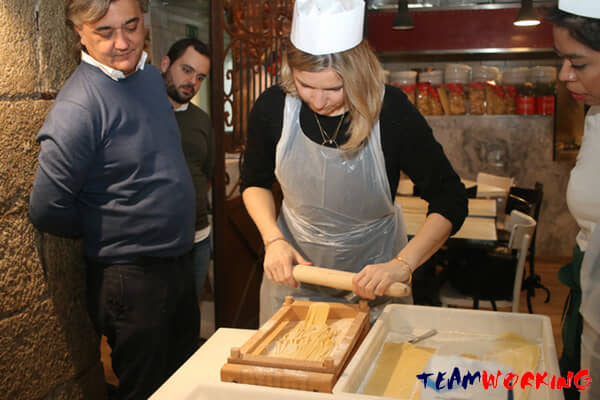
The team kneads, rolls and cuts fresh pasta.
What it looks like
A video says in thirty seconds what a page explains in a thousand words: how loud it gets, how much laughing there is, what the hands are doing.
What it is
Given our Italian roots, this is a must among our culinary activities. For a morning or an afternoon the kitchen turns into a pasta factory: divided into groups, people learn to make some of the best-known shapes from scratch, guided by professional chefs. From spaghetti, ravioli, tortellini, tagliatelle and gnocchi to rarer old varieties like spaghetti alla chitarra. Italy has more than a hundred kinds of pasta, and the teams get through as many as they can. At the end the table gets laid and everyone eats what came out of their own hands.
When it makes sense to choose it
It works well with large, mixed groups. Hands keep working even when languages don’t match: someone who doesn’t speak the language learns by watching the person next to them, and within half an hour the barrier has gone.
It works well too when there are people in the group who don’t want to be exposed. Kneading is something you do with your head down, and talking comes on its own precisely because nobody is looking at you.
It works less well if you’re after competition or adrenaline: the pace here is slow by construction, and that’s why it works.
How it actually works
It starts with a short explanation: how to be in a kitchen, what you touch and what you don’t. Then the group splits into teams and each takes a station, with water, eggs, salt and flour, the simple, essential ingredients of real Italian pasta. Aprons and hats on, and hands in the dough.
Each team makes a different shape, with dough machines, rolling pins, cutters and scales. Someone rolls the sheet, someone makes the filling, someone closes the ravioli one at a time, and the first ones come out badly, always. You learn that pasta doesn’t forgive being rushed: if the dough hasn’t rested, it tears when you roll it.
In Italy there’s a tradition of families gathering to make pasta together for the holidays, guided by whoever knows how, rolling out dough and shaping it while the stories and the laughing go round. That atmosphere is precisely what gets recreated here with colleagues.
Then you cook, lay the table and sit down. This part is half the format. The fresh pasta gets dressed with olive oil, fresh tomato and basil, and everyone tastes a dish they made with their own hands. The day after, the team has been through a whole process from beginning to end, and it trusts what somebody else’s hands did.
Three questions
How many people does it hold?
It’s the format in the Cooking family that scales best, because it doesn’t depend on an oven but on the number of stations. We’ve run cooking events from four people up to three hundred.
How long does it take?
Around three hours, lunch or dinner included.
What about allergies and diets?
They’re handled in advance: allergies, intolerances and dietary preferences, vegan and vegetarian included, always have to be known before the day. Gluten-free and vegetarian versions are made at separate stations.
When what surfaces deserves an afterwards
An activity surfaces a great deal about how a team communicates, decides and works together, and sometimes what surfaces deserves more time, more depth and a method. That is where a Team Coaching path can begin: a different road, to be taken only if it is needed, to turn what the day made visible into a new way of working together.
Discover Team Coaching →
Let’s talk about your next team building
You don’t need to have picked a format yet. Tell us what you want your team to take home, how many of you there are and where you’ll be, and we’ll do the rest: within 24 hours you get a considered proposal for your case, with the formats that hold up against your numbers, and what each one leaves the team the day after.
Prefer to talk? +971 50 795 9666 · info @ teambuildingincentive.ae