
Outdoor Team Building
The team takes on exercises in the open air, one after another.
What it looks like
A video says in thirty seconds what a page explains in a thousand words: how loud it gets, how much running there is, what happens when the plank falls.
At the office a problem can be pushed to the next meeting, or hidden inside an email with the manager copied in. On open ground, with an exercise to get through and ten minutes on the clock, it gets solved or it gets lost, in front of everyone. That’s why outdoor exists: when the place changes, so do the excuses.
What it is
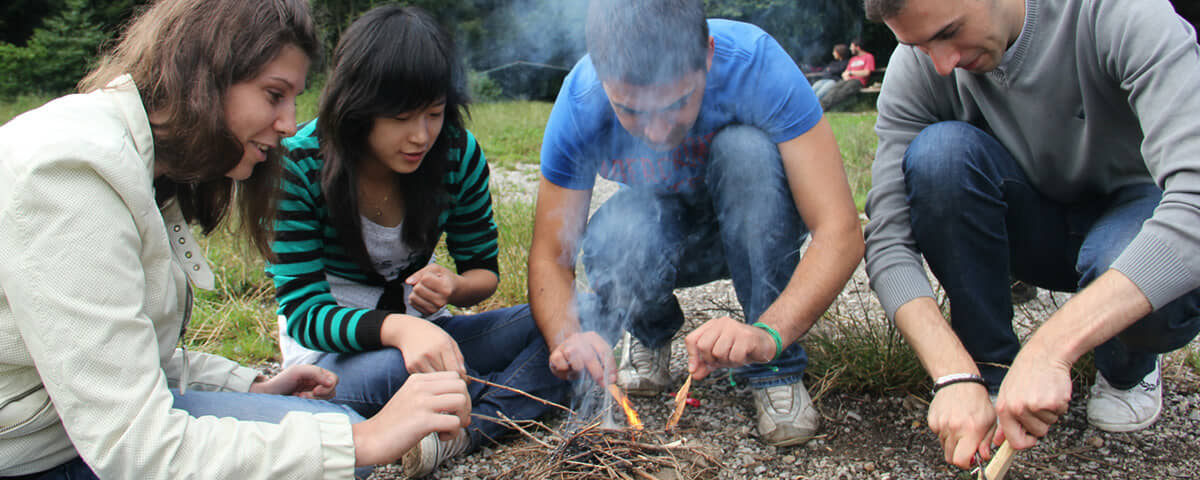
A succession of exercises in the open air, all different from each other and at a fast tempo: objectives to reach under precise rules, obstacles to get past, races against the clock, and challenges run both inside a team and against the other teams. Every exercise opens with a briefing that sets out three things, the goal to reach, the resources available and the deadline, and closes with a debrief. Over the years they’ve worked with teams of every nationality, age and professional background.
What changes compared with a day of indoor training is the place. Open ground, a park, a stretch of sand: the space is large, you can run, you can raise your voice, and the teams lose sight of each other between one exercise and the next. Those conditions change the way a group organises itself, and make it visible. If the place doesn’t matter to you and only the design of the day does, the same logic indoors is called Experiential Training.
Where it comes from
Outdoor training has a date of birth: 1941, Aberdovey, Wales, where Kurt Hahn opened the first Outward Bound school to prepare young sailors to withstand the sea. The idea was simple: you learn in front of a real difficulty, and you learn together. From the 1970s that model entered management training, and from there team building. We keep the principle and leave the rhetoric: the ground is the pretext, the team is the content.
What it makes visible
Outdoors the feedback is immediate and not up for discussion: the plank falls, the rope goes slack, the team arrives late. Nobody has to tell a colleague they got it wrong, because they watched it. A large space forces people to communicate explicitly, since at thirty metres you can’t hear or see each other. The fast tempo removes the time for meetings and shows who decides when deciding costs something. And the effort, small but real, switches off the office roles: out there the org chart weighs less than a pair of wet shoes.
How it works
The day is organised into stations, and the sub-groups rotate between them. The exercises come in two kinds and alternate: the physical ones, where the body is part of the problem, and the relational ones, where the problem is reaching agreement. Exercises like an area to cross without touching the ground using three planks and six people, an object to move with ropes held by everyone, a route to walk blindfolded guided only by a voice, a structure to build from what’s there in a time that isn’t enough.
Every exercise has a briefing, which gives the rules, the objective and the time, and a short debrief while what happened is still fresh. At the end of the day there’s the long debrief, everyone together, with the trainer who watched every station and can say which behaviours carried the team and which held it back.
Where it happens
We run it in Dubai, in Abu Dhabi and across the GCC. A field or a beach is enough, along with a covered point for the briefing and the debrief.
The timing depends on the daylight and on the heat: it’s one of the first things we ask about when building the programme.
And if the weather doesn’t cooperate
It’s far from a detail, and we put it in the quotation in writing. Alongside the Outdoor we always propose a more flexible alternative that adapts to the conditions on the day: Survival, or a day of Experiential Training that moves indoors without losing the objective. The same goes for any physical limitations among the participants, which often come to light at the last minute.
What you take home
The exercises ask people to get to know each other quickly, to trust work somebody else did, and to decide without having all the information. None of them lets anyone stand aside: they’re built so that a group that leaves somebody behind loses.
In the debrief you look at which attitudes helped the team and which slowed it down, on the basis of what actually happened and not of what should have been done. It’s the part that separates a good day in the open air from a day that still shows the day after: everyone remembers an outdoor exercise for years, the debrief is there so they also remember what it taught them.
When it makes sense
It works well if the group is large and mixed, if you want the day to stay in the team’s memory as something done together, and if there’s an objective the debrief can pick up: the group will keep working together.
It works less well if you have less than half a day, or if the objective is fine work on a conflict between two people: that needs more reflective formats, indoors.
Three questions
Do you need to be fit?
No. The exercises ask for coordination and thinking before breath. They’re designed for groups mixed in age and physical condition, and anyone with a limitation always has a role inside the exercise.
How long does it take?
A day, briefing and debrief included. A half day exists, with fewer exercises.
How many people does it hold?
Up to around a hundred, in sub-groups rotating between the stations. Below twelve people it gives less, because a lot of the exercises live on the comparison between teams. Large groups, as it happens, are where the research sees the biggest effect: the meta-analysis by Klein and colleagues (2009) finds that the benefit of team building grows with the size of the team.
The day after, the team has a day in common that it will remember for years, and a debrief that told them what to do with it.
When what surfaces deserves an afterwards
An activity surfaces a great deal about how a team communicates, decides and works together, and sometimes what surfaces deserves more time, more depth and a method. That is where a Team Coaching path can begin: a different road, to be taken only if it is needed, to turn what the day made visible into a new way of working together.
Discover Team Coaching →
Let’s talk about your next team building
You don’t need to have picked a format yet. Tell us what you want your team to take home, how many of you there are and where you’ll be, and we’ll do the rest: within 24 hours you get a considered proposal for your case, with the formats that hold up against your numbers, and what each one leaves the team the day after.
Prefer to talk? +971 50 795 9666 · info @ teambuildingincentive.ae