
Experiential Training
A day built backwards: the objective first, the exercises after.
What it looks like
A video says in thirty seconds what a page explains in a thousand words: the rhythm of it, what the hands are doing, how the voices change in the debrief.
The course on teamwork finished a month ago. The slides are in the shared folder, the feedback form came back at four and a half out of five, and the meetings are exactly the same as before. That happens because in a training room you learn what you ought to do, and then the group goes back to doing what it did. Experiential training starts from the other side: from what the group actually does, put in a position to see it.
What it is
A sequence of exercises designed to measure for a stated objective. No theme and no costumes: exercises built so that in a few hours what takes six months at the office happens in front of everyone, and a debrief that carries it back to the next working day. Chris Argyris called that gap espoused theory and theory-in-use: what we say we do and what we do under pressure. A well-built exercise puts the group into the second one, in front of everybody.
It’s the format to choose when the objective is clear and the setting isn’t needed. If the setting does help, whether that’s the stage, the city, the map or the desert, there are formats in the same family that start from there. And if the place matters, a park, room to run, the same logic outdoors is called Outdoor Team Building.
The cycle we follow on all of our days, experience, observation, awareness, alignment and action, is described on the Method page. Here we’re talking about this one day.
What it makes visible
An exercise with rules that can’t be worked around, a clock that runs out, and information distributed so that nobody has all of it. In twenty minutes you see who takes the decision and who has it taken for them, who asks and who assumes, who keeps time and who loses it, how the group reacts to the first mistake. These are the same things that at the office take six months to see, spread across meetings and emails, where everybody tells it their own way. Here everyone watched the same scene, and it can be discussed without anyone having to defend themselves: you talk about the exercise, and the exercise is the group.
How the day gets built
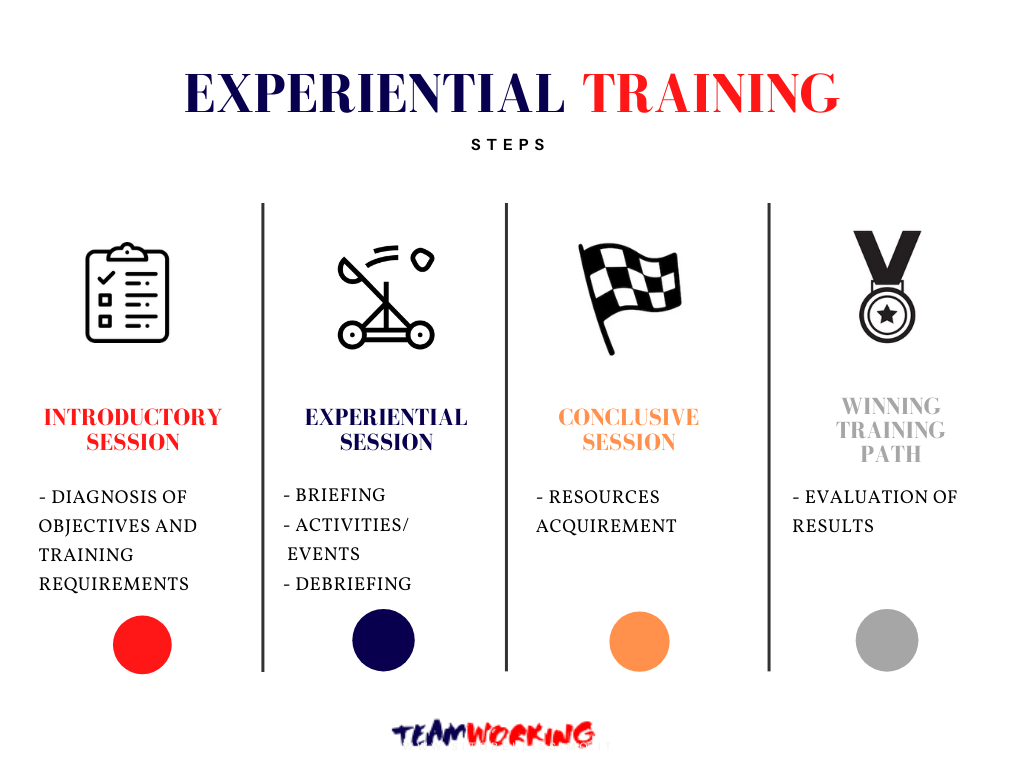
You start from the end. You tell us what has to be different when the participants go back to work: meetings that don’t decide, two departments talking badly to each other, a newly assembled group that doesn’t yet trust itself. From that sentence we work back to the behaviour that has to change, and from the behaviour to the exercises that surface it. We choose the exercises last, because they’re the means. It’s the opposite of the way a team building usually gets bought, where the activity is chosen first and an objective to justify it comes second.
Then the day always has the same shape. A briefing with you. A briefing with the participants, who know they’re in training: that’s what makes the rest possible. The exercises. The debrief. The debrief is the half that counts, and it’s the one usually cut when this gets bought elsewhere.
The research here is unambiguous. A meta-analysis across 46 studies and more than two thousand people (Tannenbaum and Cerasoli, Human Factors, 2013) measured that a well-conducted debrief improves the effectiveness of individuals and teams by around 25% compared with not doing one, and that structure, facilitation and a shared objective increase the effect. It’s why our day has a trainer who observes and protected time to talk it through, and why a half day reduces the exercises and never the reflection.
What the participants do
Exercises quite unlike each other, at a fast tempo: an objective to reach under rules that can’t be worked around, a time constraint, information distributed so that nobody has all of it. Little physical effort is needed and no extroversion at all: what’s being observed is how the group decides, before how fast it runs.
Between one exercise and the next you look at what happened while it’s still fresh. The trainer brings the questions, prepared beforehand around the objective, and keeps the answers to themselves: the answers that count are the ones the group finds on its own scene.
What you take home
Three things. The behaviour, with a name on it: the group has seen what blocks it and knows what to call it. A shared language, because ‘like in the rope exercise’ becomes a quick way of saying something in a meeting. And one or two decisions taken together, said out loud before people leave, which are in force the next day.
There’s research behind this too. The meta-analysis by Klein and colleagues (Small Group Research, 2009) finds that team building has a positive effect on every team outcome, strongest on climate and on process, and that the most effective components are work on objectives and clarity of roles. A day built backwards from the objective does exactly that.
When it makes sense
It works well if you have an objective you can say in one sentence, if there’s somebody in the company willing to do the opening briefing properly, and if the group will keep working together: a debrief only makes sense if there’s an afterwards.
It works less well if the occasion is a celebration or a reward: there you want an experience to remember, and you’ll find it in another family.
Three questions
Indoors or outdoors?
Both. When the weather allows it a lot of the exercises give more outdoors, but the day doesn’t depend on it: an indoor version exists for every exercise.
How long does it take?
The usual size is a full day. Half a day can be done, but the debrief has to be kept regardless: you reduce the exercises, never the reflection.
How many people?
From eight to around a hundred. Above thirty you work in parallel sub-groups with a trainer each, and the final debrief happens first by group and then all together.
The day after, the group has a scene in common, a name for what was blocking it and a decision already in force. The rest is their own work, and if they want a hand with it, Team Coaching starts from there.
When what surfaces deserves an afterwards
An activity surfaces a great deal about how a team communicates, decides and works together, and sometimes what surfaces deserves more time, more depth and a method. That is where a Team Coaching path can begin: a different road, to be taken only if it is needed, to turn what the day made visible into a new way of working together.
Discover Team Coaching →
Let’s talk about your next team building
You don’t need to have picked a format yet. Tell us what you want your team to take home, how many of you there are and where you’ll be, and we’ll do the rest: within 24 hours you get a considered proposal for your case, with the formats that hold up against your numbers, and what each one leaves the team the day after.
Prefer to talk? +971 50 795 9666 · info @ teambuildingincentive.ae