
Crazy Car Race
The team builds a little car and takes it racing.
What it is
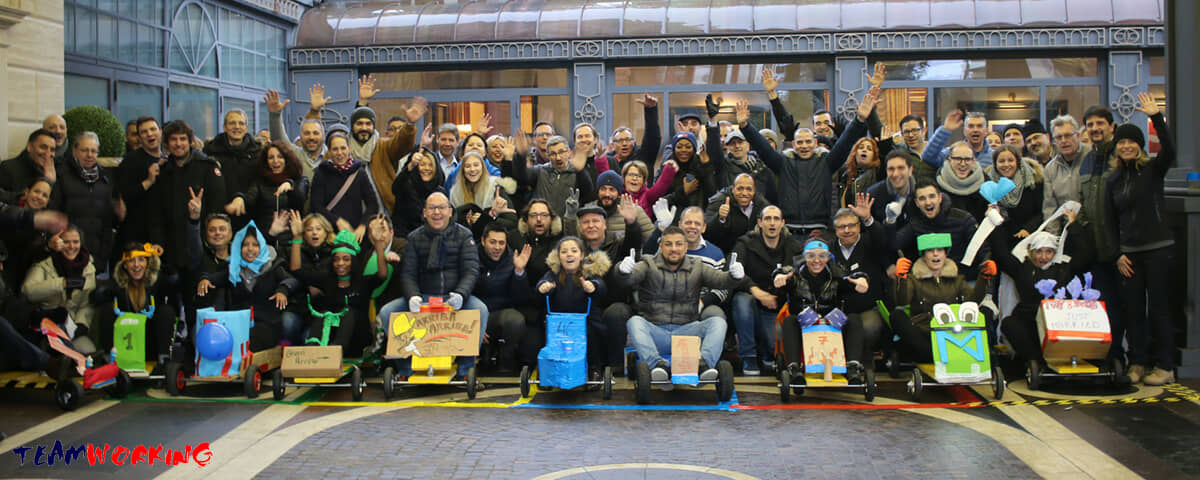
Teams design and build a mini car with no motor, completely ecological, out of salvaged and recyclable materials. Then they take it to the track. The format borrows from three families at once: engineering in the design phase, creative in the decoration, action in the race.
The race judges four things: speed, handling, durability and design. Speed on its own doesn’t win it.
When it makes sense to choose it
It works well when a group contains profiles that don’t usually meet. Three different trades are needed in the same team: the one who draws the design, the one who builds and the one who decorates. Then somebody has to drive, and it isn’t necessarily one of those three.
It works well too when you want an activity that ends with something to look at. The cars stay, and they photograph well.
It works less well if you have barely half a day. The building takes real time, and compressing it takes the point out of the race.
What it looks like
A video says in thirty seconds what a page explains in a thousand words: how loud it gets, how much laughing there is, what the hands are doing.
How it actually works
After the briefing each team draws its project on paper, and the drawing gets judged. Then comes the part that surprises people: the materials for building and decorating have to be won, by getting through a series of challenges. Teams that did well in that phase find themselves with more wood, more colour and more parts to fit.
From there you plan the stages of the work, divide the tasks and build. The trainers stand by with hammers and screwdrivers, but the wooden boards and the metal parts get fitted by the teams themselves. There are no pre-packaged kits to take apart and put back together: even the wheels come from salvage and are all different sizes, so finding four the same is already a stroke of luck, and four is only the number you’d pick if imagination didn’t suggest otherwise.
Then the cars have to run. Each team chooses a driver to sit in the car and one or more pushers, who are the engine, because the car moves on the strength of their arms. Heats go off two or more cars at a time, and the challenge is being fast without tipping over. The day can close with a proper award ceremony, medals and certificates included. The day after, the team knows what its own drawing was worth once somebody had to sit in it.
Three questions
Do you need to be able to build?
No. The tools are simple and the trainers stand beside every team. What counts most is deciding early who does what, because the stages overlap.
Is it genuinely low-impact?
The car has no motor and every material is salvaged and recyclable: metal, wood, cardboard, paper for the decoration, and no plastic at all. That same constraint is what makes the project difficult. It also makes the format safe enough to run as a family day, with children in the race.
Where does it happen?
You need a wide space to build in and a course to race on. A lawn, a closed-off road, a car park or a stretch of beach all work.
When what surfaces deserves an afterwards
An activity surfaces a great deal about how a team communicates, decides and works together, and sometimes what surfaces deserves more time, more depth and a method. That is where a Team Coaching path can begin: a different road, to be taken only if it is needed, to turn what the day made visible into a new way of working together.
Discover Team Coaching →
Let’s talk about your next team building
You don’t need to have picked a format yet. Tell us what you want your team to take home, how many of you there are and where you’ll be, and we’ll do the rest: within 24 hours you get a considered proposal for your case, with the formats that hold up against your numbers, and what each one leaves the team the day after.
Prefer to talk? +971 50 795 9666 · info @ teambuildingincentive.ae