
Carton Boat
The team builds a cardboard boat and climbs aboard.
What it is
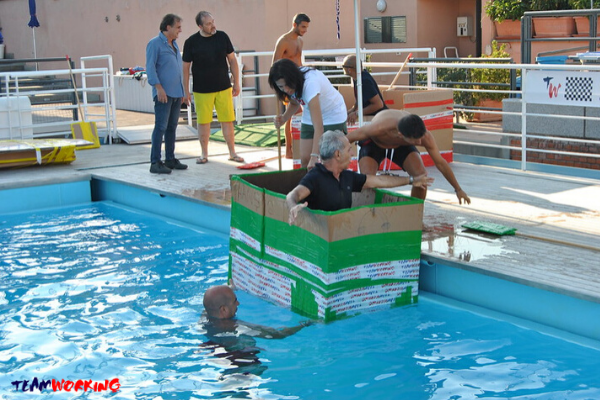
Teams design, build and sail a cardboard boat with limited materials, limited resources and limited time. The boat has one compulsory feature: it must be big enough to carry people safely, so the dimensions have to be realistic and the thing has to work.
Once it’s built you decorate it, and then the real test comes in the water, in a swimming pool or along the shore, depending on the weather and the location. We run it in Dubai, Abu Dhabi, Qatar and Saudi Arabia.
When it makes sense to choose it
It works well when very different profiles sit side by side in a group. You need someone who designs, someone who cuts and sticks precisely, someone who decorates and someone who in the end has the nerve to climb on: four different contributions, and none of them worth less than the others.
It works outdoors, and the comfortable window is when the temperature sits between 24 and 35 degrees: spring, autumn and the mild stretch of winter.
It works less well if nobody in the group wants to get wet. The final test is the point of the activity, and somebody has to climb on.
What it looks like
A video says in thirty seconds what a page explains in a thousand words: how loud it gets, how much laughing there is, what the hands are doing.
How it actually works
The day starts with a briefing, where the instructions and the materials are handed over: cardboard, scotch tape, scissors, brushes and colours, and nothing else. From there each team has to analyse the problem, assign the roles and plan before cutting, because the cardboard they have is the cardboard they have and a mistake can’t be taken back.
Then you build and decorate. The two compete for the same time, and each team has to decide how much to invest in how the boat looks and how much in whether it holds: it’s a choice you pay for or collect on twenty minutes later, in the water.
The final test is Archimedes’ principle checked with your own hands. Boats go head to head, one against another, a first round thins out the field and the survivors meet in the final. There’s an endurance test to see how long a boat stays up, a speed race that rewards rowing in time, and a stress test for the unexpected. Sometimes a boat sinks, sometimes both make it across. Prizes go in several categories, so the fastest boat, the best technique, the most creative design, the best crew and the Titanic prize for the team that kept going anyway can all find an owner. The day after, the team has a shared memory of the twenty minutes in which its own plan either floated or didn’t.
Three questions
Do you need to be able to build things?
No. Cardboard and tape need no tools and no experience. What’s needed is agreeing before anyone starts cutting.
Do you need to be able to swim?
Whoever goes aboard does, and that’s a voluntary choice. The rest of the team watches from the side.
Where does it happen?
You need water: a swimming pool, a lagoon, the sea. The building happens on land, in a large space alongside it.
When what surfaces deserves an afterwards
An activity surfaces a great deal about how a team communicates, decides and works together, and sometimes what surfaces deserves more time, more depth and a method. That is where a Team Coaching path can begin: a different road, to be taken only if it is needed, to turn what the day made visible into a new way of working together.
Discover Team Coaching →
Let’s talk about your next team building
You don’t need to have picked a format yet. Tell us what you want your team to take home, how many of you there are and where you’ll be, and we’ll do the rest: within 24 hours you get a considered proposal for your case, with the formats that hold up against your numbers, and what each one leaves the team the day after.
Prefer to talk? +971 50 795 9666 · info @ teambuildingincentive.ae