
Farm
The team works on a teaching farm, alongside the animals.
What it looks like
A video says in thirty seconds what a page explains in a thousand words: how loud it gets, how much laughing there is, what the hands are doing.
What it is
A day of real work on a farm. On one side the animals: milking, cleaning out, feeding. On the other the passage from raw material to product: milling grain and baking bread in a wood oven, making butter and cream, cheeses, preserves.
The timings are nature’s and they don’t compress. A process you begin has to be carried through, and that’s part of the format rather than a limitation of it.
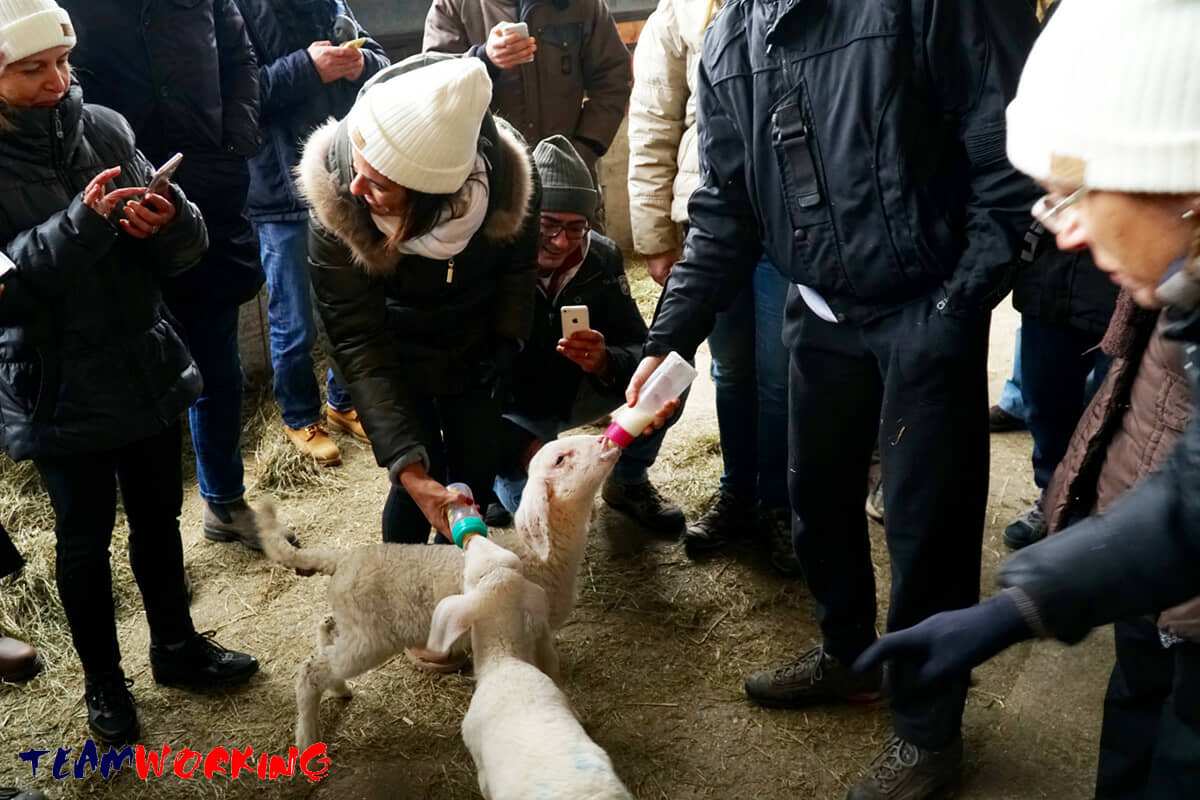
Looking at the social side of team building, there are two broad categories: work on the environment and work on people. One proposal that brings both together is the Farm.
Farm: a slow experience
The format covers a range of possibilities, from experiencing life in the fields to everything involved in going from what nature produces to what gets eaten.
It’s a way of going back to the beginning and rediscovering what was ordinary daily life for the people before us: returning to human timings, hearing again the rhythm nature sets and the work that goes with it.
The timings and the procedures of farm work follow a completely different logic from an industrial process. On a farm the natural timings have to be strictly respected, or nothing that gets attempted works.
Compared with other team building formats, then, the farm offers less flexibility about time: you can’t expect to grow wheat and bake bread in an hour. You can’t leave a process half-finished once it has started, either, because it has to be carried through following the traditional steps. Those are characteristics of the format rather than limits on it.
What happens on a Farm day
The activities can be very different from each other. First, obviously, everything to do with the animals: milking, cleaning out the stalls, and feeding the animals and the birds on the farm.
It’s also possible to get involved in producing natural food. There are a great many different options here: milling grain and baking bread in a wood oven; making butter and cream; making cheese; preparing preserves.
The focus, in every case, is on finding a dimension closer to nature and on developing an awareness of the products we consume every day.
Spending a day on a farm puts the right value back on products, on timings and on natural processes. It’s a rediscovery to be carried across as a metaphor into your own team, to get back to the values that hold for a person and for an organisation.
The ecological side
And the ecological side of this activity isn’t negligible either: it builds a greater awareness of how materials can be reused.
On a farm nothing goes to waste: what’s left over from one kind of production supplies the material for another. Leftovers from growing become feed for the animals, while the animals in turn produce fertiliser for the fields.
When what surfaces deserves an afterwards
An activity surfaces a great deal about how a team communicates, decides and works together, and sometimes what surfaces deserves more time, more depth and a method. That is where a Team Coaching path can begin: a different road, to be taken only if it is needed, to turn what the day made visible into a new way of working together.
Discover Team Coaching →
Let’s talk about your next team building
You don’t need to have picked a format yet. Tell us what you want your team to take home, how many of you there are and where you’ll be, and we’ll do the rest: within 24 hours you get a considered proposal for your case, with the formats that hold up against your numbers, and what each one leaves the team the day after.
Prefer to talk? +971 50 795 9666 · info @ teambuildingincentive.ae